
First-Generation College Students Are A Tri-C Priority
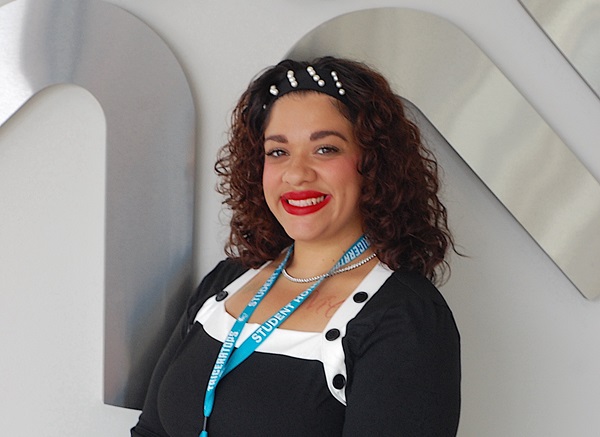
College can make any person feel like a stranger in a strange land, but for first-generation students, that feeling can be amplified by orders of magnitude.
“My father is from Nicaragua, and he didn't finish high school because a war broke out in his country,” said Abigail Zuniga, a first-generation student at Cuyahoga Community College (Tri-C®). “My mother comes from a poor white family from West Virginia.
“When I first came to Tri-C, I didn’t know what I was doing. I saw a lot of other students there with their parents guiding them, and I was like, ‘Dang. My parents don’t know any of this stuff.’”
The role that college familiarity can play in a student’s academic life is subtle but powerful. When the parents have earned a degree, college is part of the background noise in the home. It creates a vernacular and a context that almost subconsciously allows a student to feel like they belong on campus when the time comes.
"There’s just one extra step that first-gen students have to take that maybe the others don’t."
A first-generation student is one whose parents didn’t complete a degree. It’s hard to pin them down as a group, but they tend to come from lower-income families. In some cases, their communities may even ridicule college.
“There’s just one extra step that first-gen students have to take that maybe the others don’t,” Zuniga said. “It’s knowing the right questions to ask. It’s not a question of whether there are resources to help you. It’s a question of, ‘Do I know that there are resources?’ It’s scary because they’re realizing, ‘Here I am, taking this leap of faith that nobody I know has done.’”
These conditions are what administrators at Tri-C call barriers, and there is a team at the College that helps students overcome them.
A seat at the table
“The first thing I think about is support,” said Lana Benton, program manager for TRIO on the College’s Metropolitan Campus. “If you’re a student who’s not first-gen, you may have sat around the table and heard Mom or Dad talk about college and talk about their experience. You may have even visited a college campus. First-gen students — not at all. They haven’t sat around the table.”
TRIO is a federally funded program that helps lower-income students succeed in college. Benton said almost all of the 200 students she served on the Metro Campus were first-generation and added that funding for TRIO at Tri-C was stable.
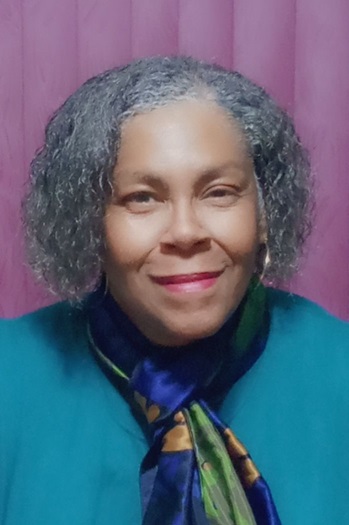
Tri-C has TRIO Student Support Services offices on its Eastern, Metro and Western campuses. The TRIO Educational Opportunity Center is housed at the Jerry Sue Thornton Center. TRIO Educational Talent Search, Upward Bound, and Upward Bound Math and Science are housed at the Metro Campus.
Zuniga found her way to the TRIO program when an email from the College brought it to her attention. It provided the bridge that allowed her to cross confidently into college life. She learned the nuts and bolts of being a student at Tri-C, but, more importantly, she learned that she belonged.
Benton said that even as TRIO introduces students to campus resources like financial aid and academic advising, one of its most important jobs is introducing first-gen students to other first-gen students. It not only shows them they are not alone but also gives them a sense of purpose. No one can understand and help a first-gen student like another first-gen student.
“I saw the difference that one small organization can make, and it’s become a goal of mine to make sure that everybody knows all the opportunities that they have,” Zuniga said.
Zuniga, a mother of six whose husband is a truck driver, is majoring in psychology and plans to eventually pursue a doctorate. She is the Student Government president at the Eastern Campus. Her goal is to create an organization that helps foster kids aging out of the system attain their bachelor’s degrees.
Tri-C steps up
Statewide, 37% of college populations are first-generation students. That number is higher in Northeast Ohio due to many factors: more people going directly into the workforce, lower rates of degree attainment, NEO’s industrial heritage and a large immigrant population.
At Tri-C, 56% of enrolled students are first-generation, a figure that has remained consistent over the years, fluctuating between 56% and 58%.
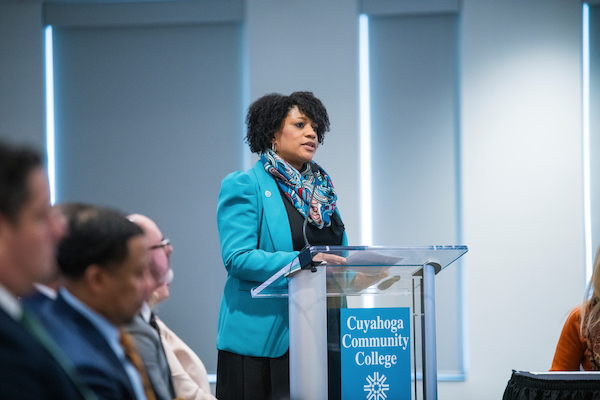
Recognizing this, in 2018, Tri-C zeroed in on the success of first-generation students. Support responsibilities were extended from TRIO to the College as a whole, with TRIO maintaining a lead role.
A new slogan began appearing on T-shirts and banners around the College. It read, “It Takes Courage To Be the First.”
“How do we help these students deal with imposter syndrome, build the resilience and the grit to persist, learn how to navigate the community or the College system, build agency and advocacy for themselves and for others, but really still feel like they belong here?” Angela Johnson, Ed.D., vice president of enrollment management, said. “We want to help them build that sense of belonging and mattering — not just at Tri-C but as college scholars.”
The College created the First Scholars Institute, developed to build community and a sense of belonging for first-gen students. It offers ongoing programming, like the First Scholars Symposium and themed events on, for example, financial planning. In addition, it teaches faculty and staff how to support first-generation students and sets measurable goals to increase first-generation student success.
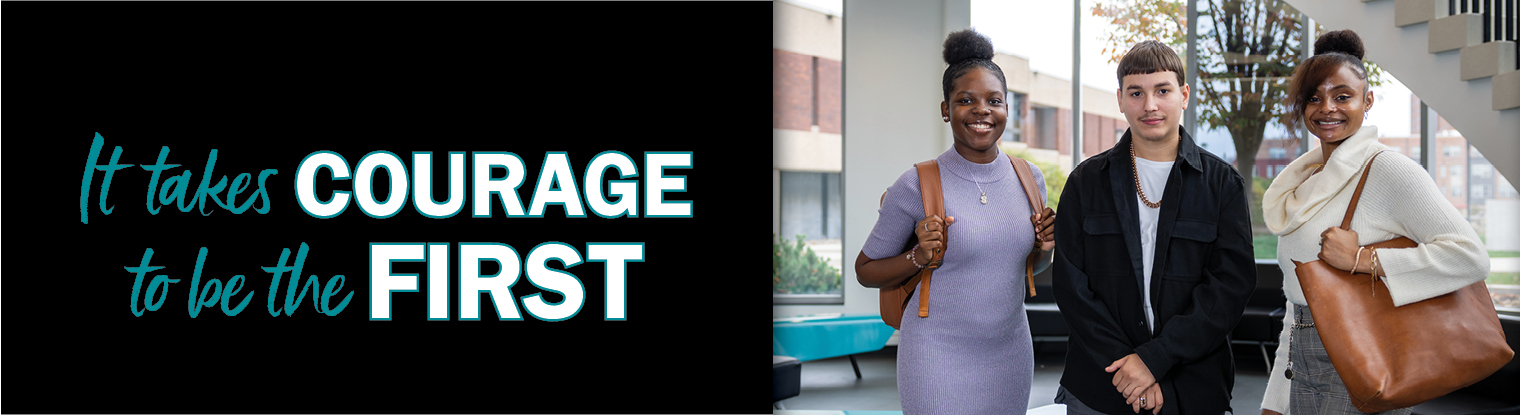 Tri-C also introduced First Scholar Advocates — staff and faculty committed to ensuring the success and empowerment of first-gen students by providing support through social, emotional, academic and financial resources.
“There were a lot of scary things as a first-generation student, and that’s what made it hard — not having the confidence in me to do this. But when I got here, I became a light,” Zuniga said. “I just blossomed beautifully here, and I love it.”
These Collegewide initiatives work in concert with TRIO to create a powerful advocacy system for first-gen students that helps them acclimate to college and, ultimately, persist and earn their degrees or certificates. FirstGen Forward, a national advocacy organization, advanced the College to the highest phase of the First Scholars Network of Institutions. Tri-C is one of only 18 higher education institutions selected for the newest class of FirstGen Forward Network Champions.
One household at a time
Johnson said that Tri-C’s philosophical goal was to reduce the number of first-gen students to nearly zero in the future by making sure as many current first-gen students as possible earn a degree or certificate now.
“It’s imperative for us to reduce that number in our region,” Johnson said.
That imperative is being realized one household at a time.
“If my kids see me doing my homework and me going places, my kids are going to go places,” Zuniga said. “My kids are going to get good grades. If I’m studying and doing schoolwork, they’re studying and doing schoolwork.”
August 25, 2026
EDITORIAL CONTACT: Jarrod Zickefoose, 216-987-4750 or jarrod_zickefoose@tri-c.edu