
Faculty and Instructors Toolkit
Below are practical strategies and resources to help you integrate career readiness into your curriculum.
- Work-based learning framework: A tool to help you consider how experiential learning opportunities align with and enhance your courses.
- 10 example career assignments for your students: Flexible assignments you can adapt to fit your discipline, course objectives and teaching style.
- Career Exploration — Three types of information your students need: A framework, with guiding questions, to support meaningful classroom discussion.
- National Association of Colleges and Employers (NACE) competencies: Guidance to align course learning outcomes with nationally recognized career-readiness competencies.
We're here to make partnership easy — and to help our students thrive. Let us know how we can support you!
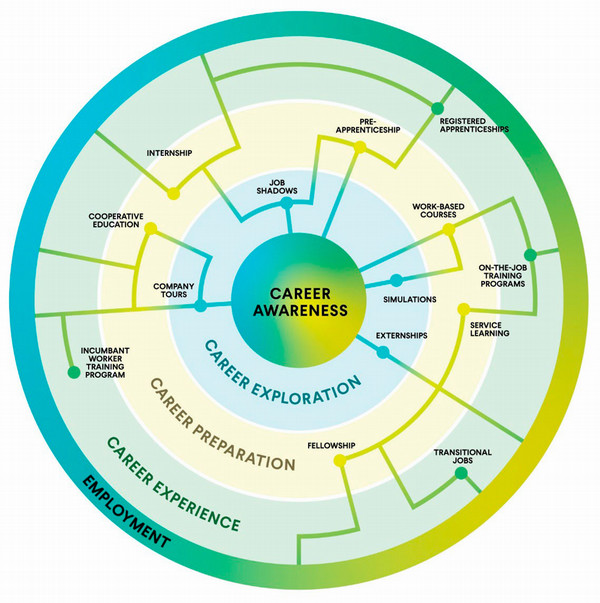 Three stages of career development and how you can partner with us
Faculty and instructors play a vital role in students' career development, and partnering with Career Services helps connect classroom learning to real-world opportunities. Use this framework as a prompt to help you think about ways to integrate types of experiential learning into your curriculum.
Through a shared approach across three stages — Exploration, Preparation and Experience — faculty and instructors can reinforce career readiness by directing students to relevant resources, embedding career conversations into coursework, and encouraging hands-on learning. Together, we can support students in discovering career paths, building professional skills, and applying their learning through meaningful work experiences that prepare them for life after graduation.
1. Exploration: Discover Career Paths
- Career Coach website
- Job shadows and informational interviews
- Company tours and employer events
2. Preparation: Build Professional Skills
- Handshake (jobs and internships)
- Resumes, cover letters and LinkedIn
- Elevator pitches, mock interviews and networking
3. Experience: Apply Learning
- Micro-internships
- Internships and co-ops
- Part-time and full-time employment
(Work-based job learning framework courtesy of Jobs for the Future website.)
Exploration
1. Take the Career Coach assessment
Have students use Lightcast Career Coach to take a brief assessment to match careers with their interests while also providing up-to-date, local data on wages, employment, job postings and associated Tri-C education and training.
2. Research two to three career paths
Instruct students to use the Federal Reserve's Occupational Mobility Explorer Tool and choose the path they prefer. (Combine this with O*NET for a deeper dive into a target career, and then have students write about what they learned. Additionally, the student could reflect on what they are learning about themselves through this research. Do they remain interested? Why is this field compelling to them? What values and interests align for them in pursuing this field?)
3. Watch Roadtrip Nation
Roadtrip Nation is a career exploration platform and PBS series that connects people with inspiring professionals through documentaries to help them find fulfilling careers. Have students watch this trailer and write a reflection.
Preparation
4. Complete an informational interview
An informational interview is a student-led conversation with a professional in a specific job, career field, industry or organization. The purpose of this assignment is for students to gain firsthand insight into a career of interest while developing professional communication and networking skills. This is not a job interview but a learning-focused discussion guided by the student's questions.
5. Update their Handshake account*
Handshake is a powerful career platform for college students. With access to over 1 million employers, Handshake provides personalized job and internship recommendations, virtual career fairs, career advice and direct connections. Every student already has an account in Handshake based on their S-Number.
Have students follow the steps below and submit a screenshot of their profile. For a deeper dive, ask students to share three work experiences they are interested in and why, and potentially draft a resume to apply to these jobs.
6. Work with us to plan a Mock Interview Day
We will work with you to bring in employers from your field and industry to facilitate mock interviews for students and give real-time feedback. This creates a safe place for students to practice the critical skills of networking and writing thank-you notes.
7. Host a resume and cover letter workshop
Reserve a computer lab and invite a Career Success Coach to guide students through developing resumes and cover letters. Students should bring a job description for a position they're interested in applying for, which will be used to create their resume and cover letter. Those unable to attend the workshop are encouraged to schedule a one-on-one resume and cover letter review with a Career Peer.
8. Complete a coaching session*
Have students schedule a coaching session in Handshake. Ask them to summarize the appointment and share one to two next steps. Appointment types include interview prep (mock interviews) and LinkedIn assistance.
Experience
9. Attend a career event within their school or academy or attend a networking event
Assign students to attend an applicable career event. Have them submit a reflection statement about their experience and share any next steps.
10. Embed an experiential learning project
Work with your school's Career Success Coaches to develop a real-world project in partnership with local employers that can be added to your curriculum.
*Handshake and Career Coaching sessions are always appropriate, at any level.
Three types of information your students need
Career exploration works best when students can connect their academic experiences to potential career paths. Faculty and instructors play an important role in making those connections, and Career Services partners with them to support these efforts. The three sets of information outlined below highlight what students need as they explore careers, with sample questions provided to help guide discussion and reflection.
Knowledge of Self
- Personal interests: What do you enjoy? What are you passionate about?
- Academic interests: What are your favorite subjects? What would you like to learn more about?
- Career or educational goals: Do you see yourself entering the workforce? Continuing your education?
- Work values: What is important to you? What rewards do you seek?
Skills: What skills and previous experience do you have to offer? What skills do you want to develop or enhance? - Finances: Is salary a key factor or motivation in your decision?
Knowledge of the Curriculum
- Have you read the course descriptions for your required classes?
- Do the course descriptions interest you?
- Did you ask your Career Coach or academic counselor specific questions about how your coursework might apply to the world of work?
- Do you know what career options are available to you by taking these courses? What skills will you develop?
Knowledge of the World of Work
- Have you completed any job shadows or informational interviews to learn more about a particular job or industry?
- Have you done internships, co-ops, clinicals or part-time jobs?
- Have you volunteered?
- Are there any experiences outside the classroom that will enable you to gauge your interests, personality, skills and value system?
 Career readiness of college graduates is critical in higher education, the labor market and the public arena.
In accordance with its mission to lead the community focused on the employment of the new college graduate, the National Association of Colleges and Employers (NACE) has developed a definition and identified competencies associated with career readiness.
NACE defines career readiness as a foundation from which to demonstrate requisite core competencies that broadly prepare the college-educated for success in the workplace and lifelong career management.
The definition and competencies help close the gap between higher education and the world of work. They lay the foundation for preparing college students for successful entry into the workforce. Please consider incorporating these into your learning outcomes.
Competencies
Career and Self-Development: Proactively develop oneself and one's career through continual personal and professional learning, awareness of one's strengths and weaknesses, navigation of career opportunities, and networking to build relationships within and outside of one's organization.
Communication: Clearly and effectively exchange information, ideas, facts and perspectives with persons inside and outside of an organization.
Critical Thinking: Identify and respond to needs based upon an understanding of situational context and logical analysis of relevant information.
Equity and Inclusion: Demonstrate the awareness, attitude, knowledge and skills required to equitably engage and include people from different cultures and backgrounds. Engage in anti-oppressive practices that actively challenge the systems, structures and policies of racism and inequity.
Leadership: Recognize and capitalize on personal and team strengths to achieve organizational goals.
Professionalism: Knowing work environments differ greatly, understand and demonstrate effective work habits, and act in the interest of the larger community and workplace.
Teamwork: Build and maintain collaborative relationships to work effectively toward common goals while appreciating diverse viewpoints and shared responsibilities.
Technology: Understand and leverage technologies ethically to enhance efficiencies, complete tasks and accomplish goals.