
Office of Institutional Progress and Effectiveness
Institutional Progress and Effectiveness (IP&E) works at the center of how the College learns and improves over time. This office brings together institutional research, planning, and applied inquiry to help the College understand what is happening for students, why those patterns are occurring, and where focused effort can strengthen progress.
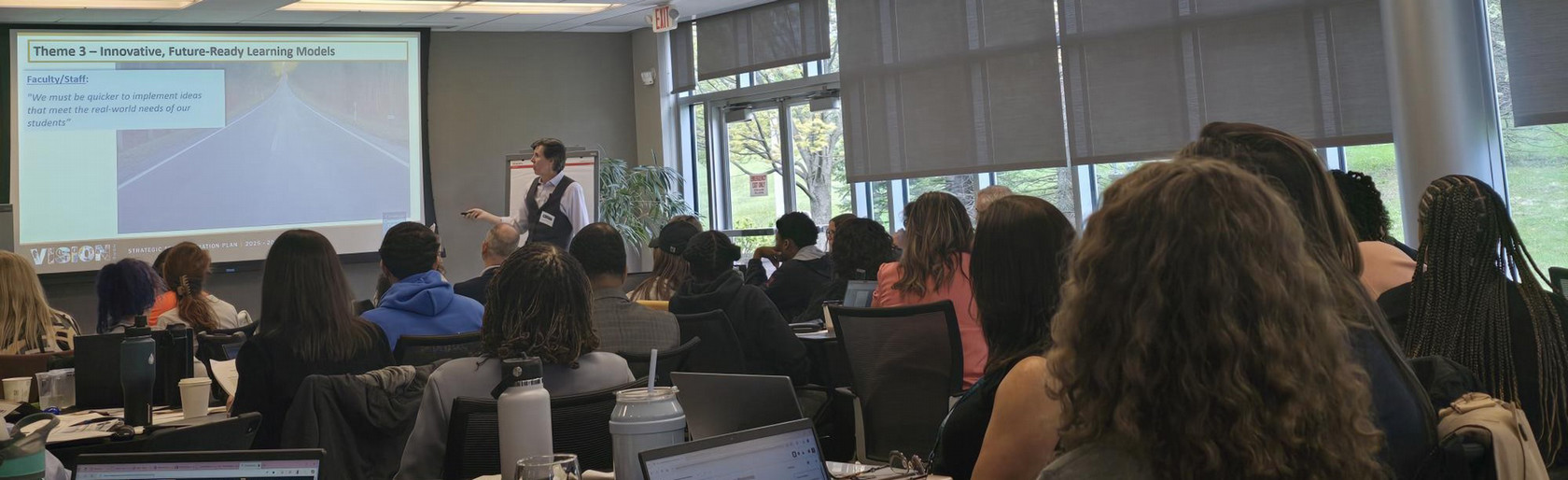
IP&E played a central role in the development of the Vision 2030 Transformation Plan, helping to ground the College's strategic direction in evidence about student experience, community conditions and institutional performance. Today, that same set of capabilities supports the ongoing implementation of Vision 2030 by helping translate shared goals into measurable improvements in student momentum, completion and community impact.
Rather than operating as a set of separate functions, IP&E is organized around a continuous cycle of understanding, alignment and improvement.
Seeing clearly: Evidence that reflects student experience
The College's ability to improve begins with a clear and shared understanding of student experience. The office develops this understanding by bringing together institutional data, student voices and program outcomes.
This work informed the development of Vision 2030 by identifying patterns in student advancement, part-time enrollment and early academic momentum that shape long-term progress. That same work continues to support implementation by helping the College monitor and refine its approach.
Survey research and applied studies help indicate how students experience the College, including the needs of adult learners and the conditions that contribute to withdrawal or persistence.
The aim is not simply to report results but also to make student experience visible in ways that can guide thoughtful action across the institution.
Focusing effort: Connecting strategy to action
Improvement depends on how clearly institutional priorities are connected to day-to-day decisions. The office reinforces this work by helping align planning, resource use and program design with the College's strategic direction.
During the development of Vision 2030, the office contributed to the framing of strategic priorities and the identification of measurable indicators. This work continues through support for enrollment planning, academic program review and the development of skills-based pathways that reflect both student demand and regional workforce opportunity.
The office works across divisions to ensure that Vision 2030 goals are translated into operational choices that shape the student experience in consistent and intentional ways.
Improving over time: Learning from results
Sustained improvement requires the ability to learn from experience and adapt. The office examines what is working, where students are encountering difficulty, and how supports can be strengthened.
As Vision 2030 moves into implementation, this work helps the College understand the effects of its efforts and identify where adjustments can improve outcomes. Through program evaluation, survey findings and focused research, the office contributes to a cycle where evidence is used to guide ongoing improvement in student progress and completion.
Where this work shows up
The work of Institutional Progress and Effectiveness is visible across the College's most important efforts and is closely connected to the priorities outlined in Vision 2030. It supports a range of institutional initiatives, including:
- Informing Vision 2030 planning and implementation
- Strengthening first-year momentum and retention
- Improving outcomes for part-time and adult learners
- Supporting the design of short-term and stackable credentials
- Aligning academic programs with regional workforce needs
- Providing evidence for program review and academic planning
In each of these areas, the office contributes to a clearer understanding of current conditions and helps identify where focused action can make the greatest difference.
Recent points of inquiry
The office regularly develops short analyses that examine specific questions about student experience and institutional performance. These efforts are designed to inform action and deepen shared understanding across the College, and many have directly informed the direction of Vision 2030.
Recent topics include:
- Adult learners at the College
- Student withdrawal patterns
- Designing for early momentum
- Developmental education performance
These inquiries reflect the College's ongoing effort to learn from its own work and strengthen conditions for student success.
Strategic Planning at Tri-C
IP&E plays a central role in advancing Vision 2030: Tri-C's Strategic Transformation Plan, ensuring that the College's priorities are guided by data, research and the voices of students, employees and community partners.